5 True Crime Cases Solved by Unexpected Clues
Some true crime cases are remembered not just because of the crimes themselves, but because of the unexpected ways the killers were finally caught.
In many of these cases, investigators spent years chasing leads. Communities were afraid, police were under pressure, and suspects seemed to stay one step ahead. But eventually, something small changed everything.
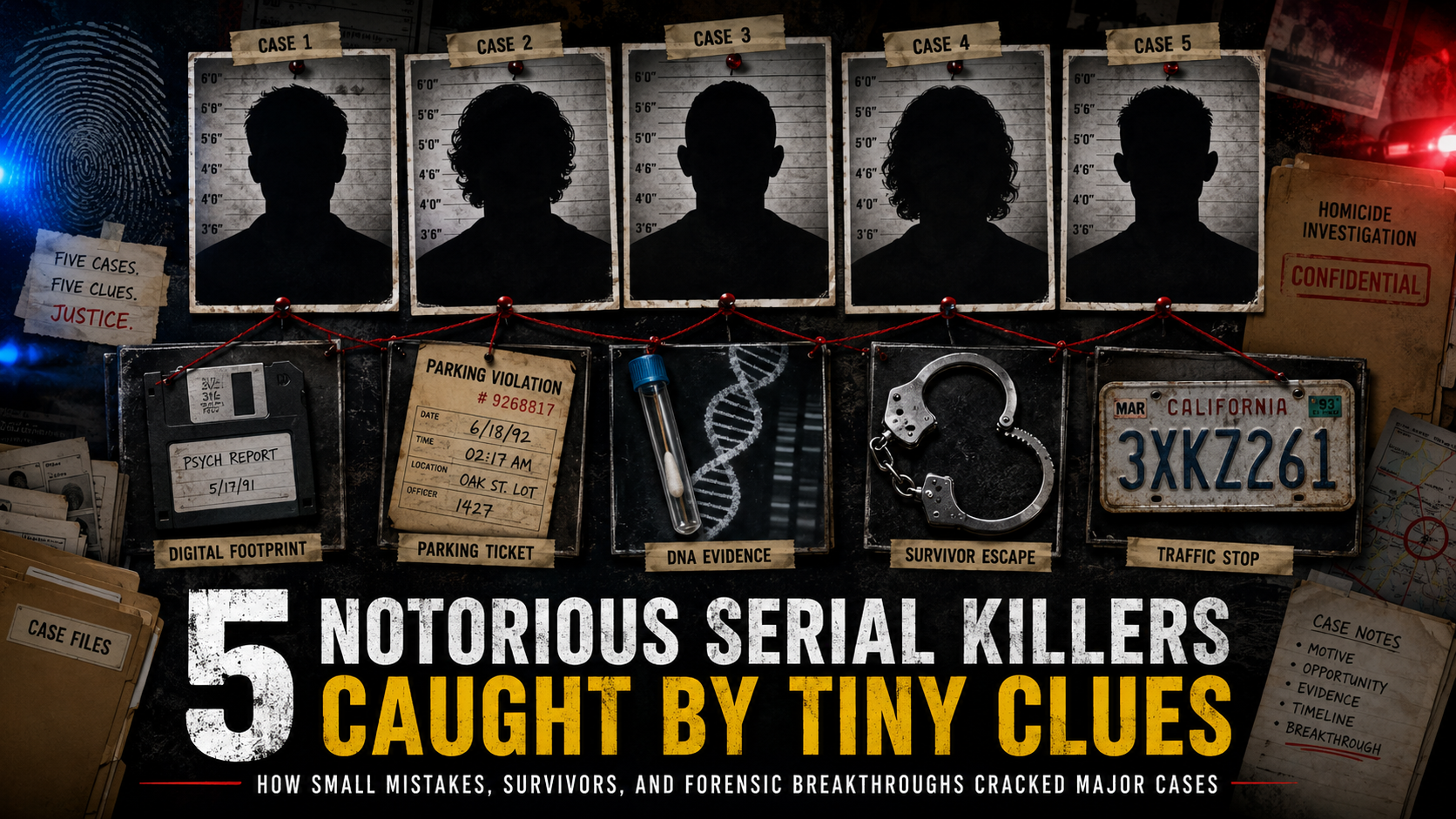
A floppy disk.
A parking ticket.
A DNA match.
A survivor escaping.
A routine traffic stop.
These five cases show how even the smallest clue can help bring an investigation to an end.
1. Dennis Rader, BTK — Caught by a Floppy Disk
Dennis Rader, known as BTK, avoided capture for decades while taunting police and the media. His nickname stood for “Bind, Torture, Kill,” and his crimes terrified Wichita, Kansas.
But after years of silence, Rader started communicating again. In 2005, he sent police a floppy disk. He likely believed it was safe, but investigators examined the disk and found hidden digital information connected to a deleted file.
That metadata helped point investigators toward Rader.
It was a major mistake. After decades of avoiding arrest, BTK was finally caught partly because of information hidden on a piece of old technology.
The lesson from the case: deleting something does not always mean it is gone.
2. David Berkowitz, Son of Sam — Caught Because of a Parking Ticket
David Berkowitz, known as the Son of Sam, caused fear across New York City in the 1970s. His attacks, letters, and threats made him one of the most infamous criminals in the city’s history.
But one of the biggest clues in the case was surprisingly ordinary: a parking ticket.
After one of the shootings, a witness remembered seeing police writing parking tickets near the scene. Investigators reviewed tickets from that area and found one connected to a car that helped lead them to Berkowitz.
That small paper trail became a major break in the investigation.
The lesson from the case: even a simple parking ticket can become the clue that breaks a case open.
3. Joseph James DeAngelo, Golden State Killer — Caught Through Genetic Genealogy
For decades, the Golden State Killer case remained unsolved. The crimes stretched across California, and the suspect disappeared before police could identify him.
Then DNA technology changed everything.
Investigators used genetic genealogy to compare crime-scene DNA with family tree information. The match did not instantly name the suspect, but it helped investigators narrow the search until they focused on Joseph James DeAngelo.
After investigators confirmed the DNA connection, DeAngelo was arrested in 2018.
This case became one of the most famous examples of how modern DNA tools can help solve cold cases decades later.
The lesson from the case: DNA can outlast time.
4. Jeffrey Dahmer — Caught After a Survivor Escaped
Jeffrey Dahmer was not caught because of a secret code or a long digital trail. He was caught because one man survived.
In 1991, Tracy Edwards escaped from Dahmer’s apartment while wearing handcuffs. He flagged down police and told them what happened.
Officers went back to the apartment with him, and what they discovered led to Dahmer’s arrest.
That escape ended Dahmer’s crimes and exposed the truth of what had been happening inside the apartment.
The lesson from the case: one survivor getting away can save future lives.
5. Peter Sutcliffe, the Yorkshire Ripper — Caught During a Routine Police Stop
Peter Sutcliffe, known as the Yorkshire Ripper, caused fear across Northern England in the 1970s and early 1980s. The investigation became one of the largest manhunts in British history.
But his capture came from a routine police stop.
In 1981, police stopped Sutcliffe and discovered that his car had false license plates. That detail led to his arrest. After further investigation, police connected him to the murders.
After years of searching, the case changed because officers noticed something wrong during what could have been a normal traffic stop.
The lesson from the case: basic police work still matters.
Final Thought
These cases are dark, and the victims should never be forgotten. But they also show something important about investigations.
Major cases are not always solved by one dramatic moment. Sometimes they are solved by small clues that seem ordinary at first.
A floppy disk.
A parking ticket.
A DNA trail.
A survivor’s escape.
Fake license plates.
Small details can change everything.