For years, a strange question has circulated across TikTok, YouTube, Facebook, and online forums:
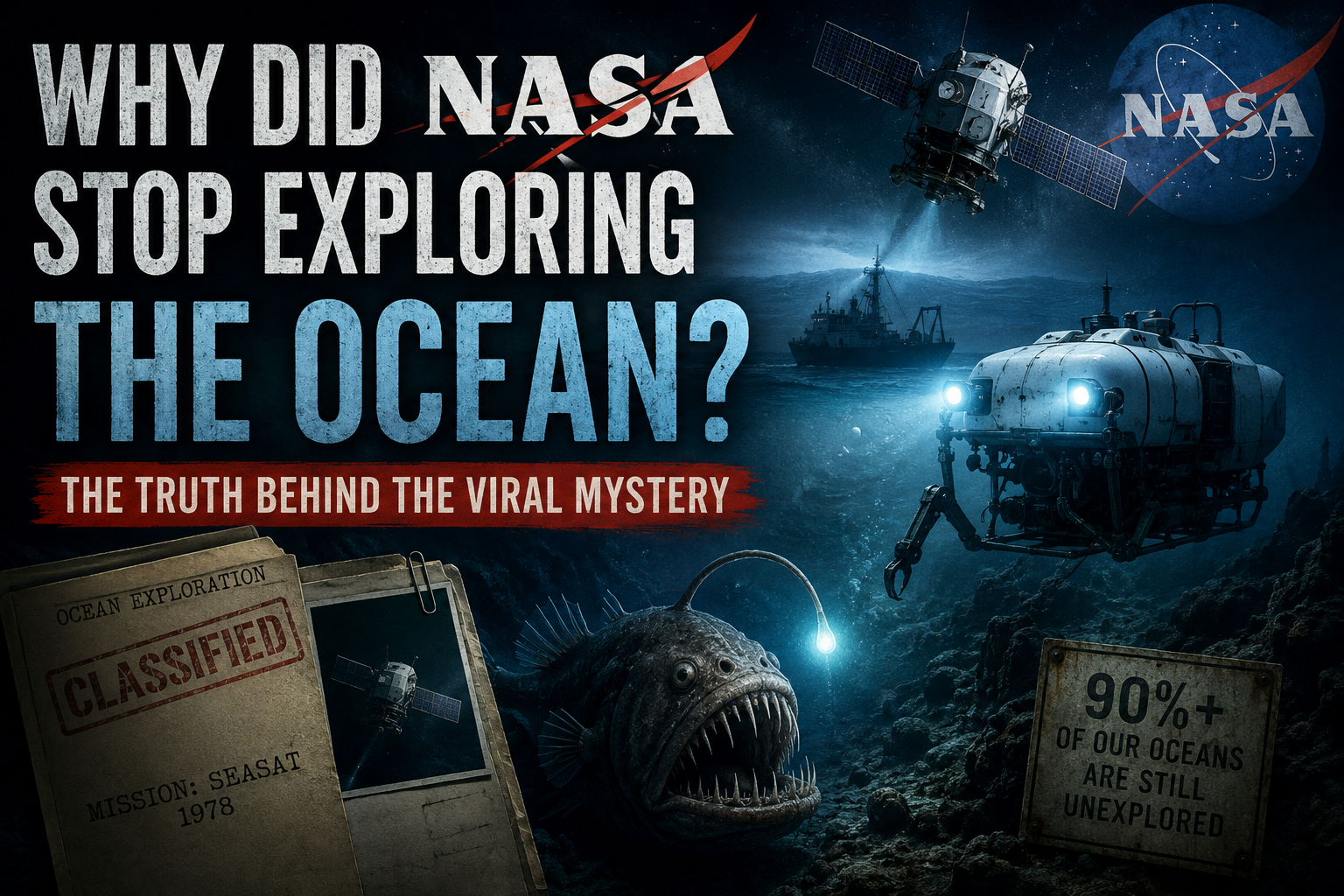
Why did NASA stop exploring the ocean?
According to one popular version of the story, NASA once focused heavily on the deep sea before suddenly abandoning ocean exploration. Some posts go even further, claiming the agency discovered something terrifying beneath the surface — something so disturbing that it turned its attention away from Earth and toward space.
It is the kind of story that seems almost believable.
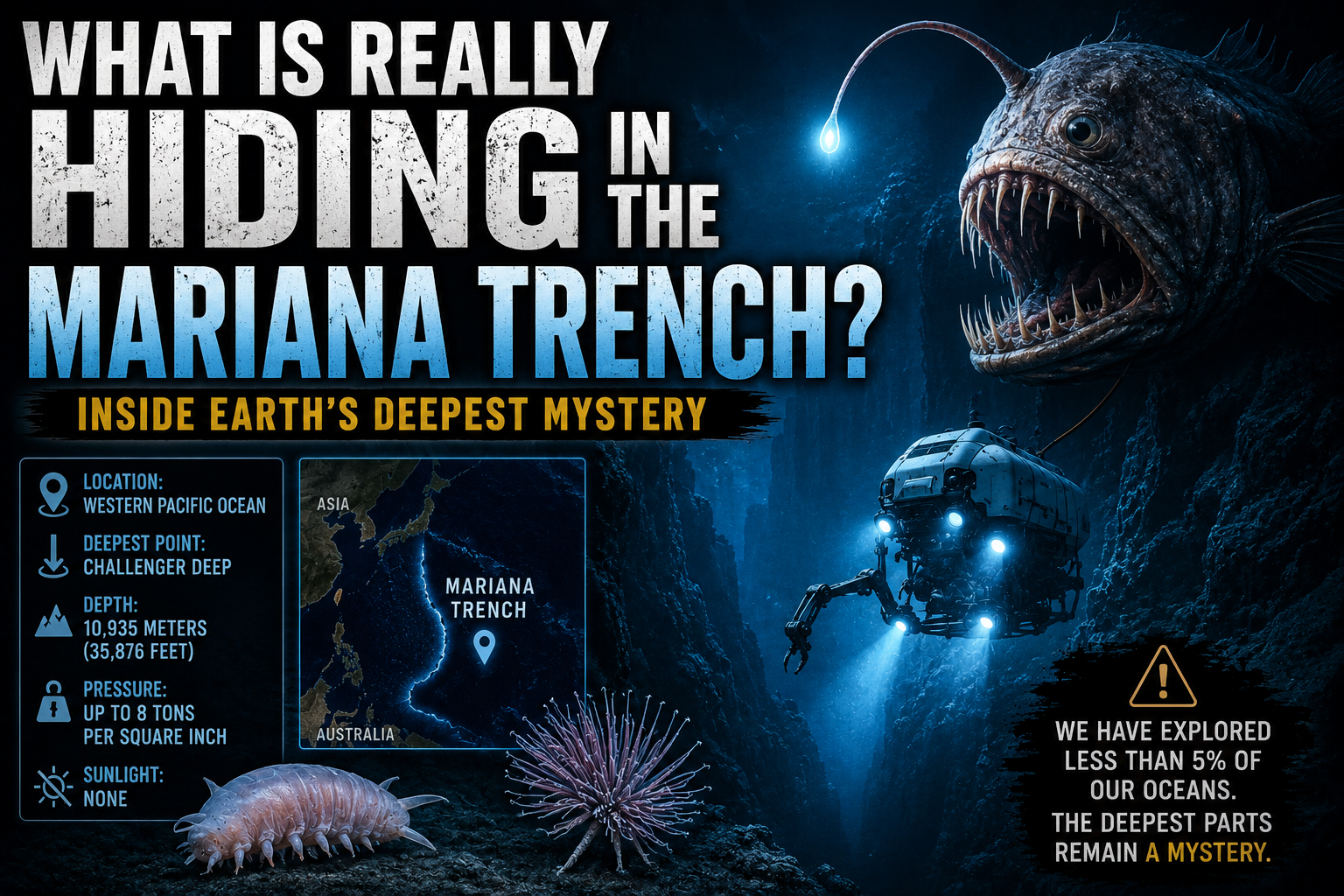
After all, the deep ocean remains one of the most mysterious environments on Earth. Strange creatures live in total darkness. Enormous sections of the seafloor are still poorly understood. Human beings have sent spacecraft billions of miles through the solar system, yet much of our own planet remains unfamiliar.
But there is one major problem with the viral story:
NASA did not suddenly stop exploring the ocean because it found something terrifying.
The real explanation is less sinister — but still surprisingly interesting.
NASA Was Never Created to Be America’s Main Deep-Sea Exploration Agency
The first thing to understand is what NASA actually is.
NASA was established in 1958 as the United States’ civilian agency for aeronautics and space. Its central mission has always focused on areas such as spaceflight, planetary science, Earth observation, aerospace technology, and research beyond Earth.
That does not mean NASA ignores the ocean.
In fact, NASA has spent decades studying Earth’s oceans. The difference is that much of this research is conducted from above, using satellites, aircraft, sensors, climate models, and partnerships with other scientific organizations.
For direct exploration of the deep ocean, another federal agency plays a much larger role: the National Oceanic and Atmospheric Administration, better known as NOAA.
NOAA Ocean Exploration describes itself as the only U.S. federal organization dedicated to exploring the deep ocean. Its work includes mapping the seafloor, investigating unknown environments, supporting expeditions, and using remotely operated vehicles to study places humans rarely reach.
So the idea that NASA was once the primary agency exploring the deep sea — and then mysteriously quit — starts with a misunderstanding of how U.S. science agencies divide their responsibilities.
Where Did the Rumor Come From?
There is no single confirmed origin for the modern conspiracy theory, but social media helped transform it into a viral mystery.
The story usually follows a dramatic pattern:
NASA explored the ocean.
NASA discovered something.
NASA became frightened.
NASA stopped looking down and started looking up.
Some versions claim this happened around the late 1970s. Others suggest that secret underwater missions uncovered unknown creatures, structures, signals, or evidence of something dangerous.
The problem is that credible historical evidence does not support those claims.
A 2024 Reuters fact-check examined versions of the rumor and found no evidence that NASA abruptly abandoned deep-sea research after a frightening discovery.
One event may have contributed to confusion: Seasat.
The Seasat Mystery — And What Actually Happened
In 1978, NASA launched Seasat, an experimental satellite designed specifically to study Earth’s oceans from space.
Seasat was a major technological achievement. It carried instruments capable of observing ocean conditions and demonstrated new ways to study the planet’s waters from orbit.
Then, after only about 105 days, the mission ended.
That short lifespan sounds suspicious when stripped of context, and it has sometimes been pulled into online speculation. But the documented explanation was not a sea monster, secret structure, or terrifying discovery.
The spacecraft suffered a technical failure.
Seasat’s mission was short, but its influence continued. The technology and scientific lessons connected to ocean observation helped shape later satellite missions and modern remote sensing.
NASA did not discover something horrifying and run away.
The agency continued studying the ocean.
NASA Still Studies the Ocean Today
This is the part the viral conspiracy theory often leaves out.
NASA continues to study Earth’s oceans because they are critical to understanding the entire planet.
The oceans influence:
- Global temperatures
- Weather patterns
- Hurricanes
- Sea-level rise
- Climate change
- Ocean circulation
- Ice melt
- Marine ecosystems
- Carbon movement through Earth’s systems
Satellites allow scientists to observe enormous areas that would be impossible to monitor continuously with ships alone.
From space, researchers can study sea-surface height, temperature patterns, currents, ocean color, phytoplankton activity, sea ice, and other large-scale changes.
NASA has also participated in projects connected to underwater technology and extreme environments.
So the claim that NASA simply “stopped exploring the ocean” is misleading.
A better description is this:
NASA studies the ocean differently than many people imagine.
Why Is So Much of the Ocean Still Unknown?
This is where the real mystery begins.
Even without a conspiracy, the deep ocean is incredibly difficult to explore.
The ocean covers more than 70 percent of Earth’s surface. Beneath that water are mountain ranges, trenches, volcanoes, canyons, hydrothermal vents, ecosystems, and enormous regions that remain difficult to observe directly.
Deep-sea exploration faces several major challenges.
Crushing Pressure
The deeper a vehicle travels, the greater the surrounding water pressure becomes.
At extreme depths, equipment must survive forces capable of destroying poorly designed structures. Building vehicles that can operate reliably in these environments is expensive and technically demanding.
Total Darkness
Sunlight disappears rapidly with depth.
Much of the deep ocean exists in permanent darkness, meaning explorers depend on artificial lighting, sonar, specialized cameras, and advanced sensors.
Communication Problems
Radio signals do not travel through seawater the same way they travel through air or space.
That makes communication, navigation, and real-time control much more difficult underwater.
Enormous Scale
The ocean is simply massive.
Exploring it is not like visiting one unknown cave or mapping one mountain range. Researchers are dealing with a global environment covering most of the planet.
This is one reason the statement that “we know more about space than our own oceans” feels so powerful. The exact comparison can be oversimplified, but the underlying reality is true: enormous portions of the deep ocean remain poorly observed and unexplored in detail.
Did NASA Find Something Terrifying?
There is no credible evidence that NASA abandoned ocean exploration because it discovered a monster, alien structure, unknown civilization, or hidden threat.
But the ocean has produced discoveries strange enough to explain why people are fascinated by the possibility.
Scientists have documented:
- Giant squid
- Goblin sharks
- Anglerfish
- Transparent deep-sea animals
- Creatures that generate their own light
- Hydrothermal vent ecosystems
- Species surviving under extreme pressure
- Animals that look almost extraterrestrial
Many of these creatures were unknown to science until relatively recently.
And new species continue to be discovered.
That reality makes the deep ocean perfect territory for conspiracy theories. When scientists openly admit that major parts of an environment remain poorly understood, people naturally wonder what else could be hiding there.
The Real Reason NASA “Stopped” Exploring the Ocean
The simplest answer is that NASA never stopped.
More importantly, NASA was never the primary U.S. agency responsible for sending ships and submersibles into the deep sea.
NASA’s role has largely centered on studying Earth as a connected planetary system, often using satellites and advanced remote-sensing technology. NOAA and other scientific institutions take a more direct role in deep-ocean exploration.
The viral story appears to combine several real facts:
NASA does study the ocean.
The deep sea remains mysterious.
A NASA ocean-observing satellite launched in 1978 and failed after roughly 105 days.
Much of the ocean is still poorly understood.
Scientists continue discovering bizarre creatures.
Mix those facts together, remove the context, add a frightening soundtrack — and suddenly you have a conspiracy theory claiming NASA found something in the darkness and fled to space.
Final Thought
The truth may not involve a secret monster hiding at the bottom of the ocean.
But perhaps the real story is unsettling enough.
Humanity lives on a planet dominated by water, yet vast regions of that underwater world remain difficult to access and poorly understood. There are ecosystems we have barely observed, species we have not identified, and geological features still being mapped in greater detail.
NASA did not abandon the ocean because it discovered something terrifying.
But that does not mean the ocean has revealed all of its secrets.
And maybe that is why the rumor refuses to disappear.