There is a place on Earth so deep that sunlight never reaches it.
A place where the pressure is powerful enough to destroy ordinary submarines, where strange animals survive in permanent darkness, and where humans have only managed brief glimpses of a world that seems almost alien.
This place is the Mariana Trench.
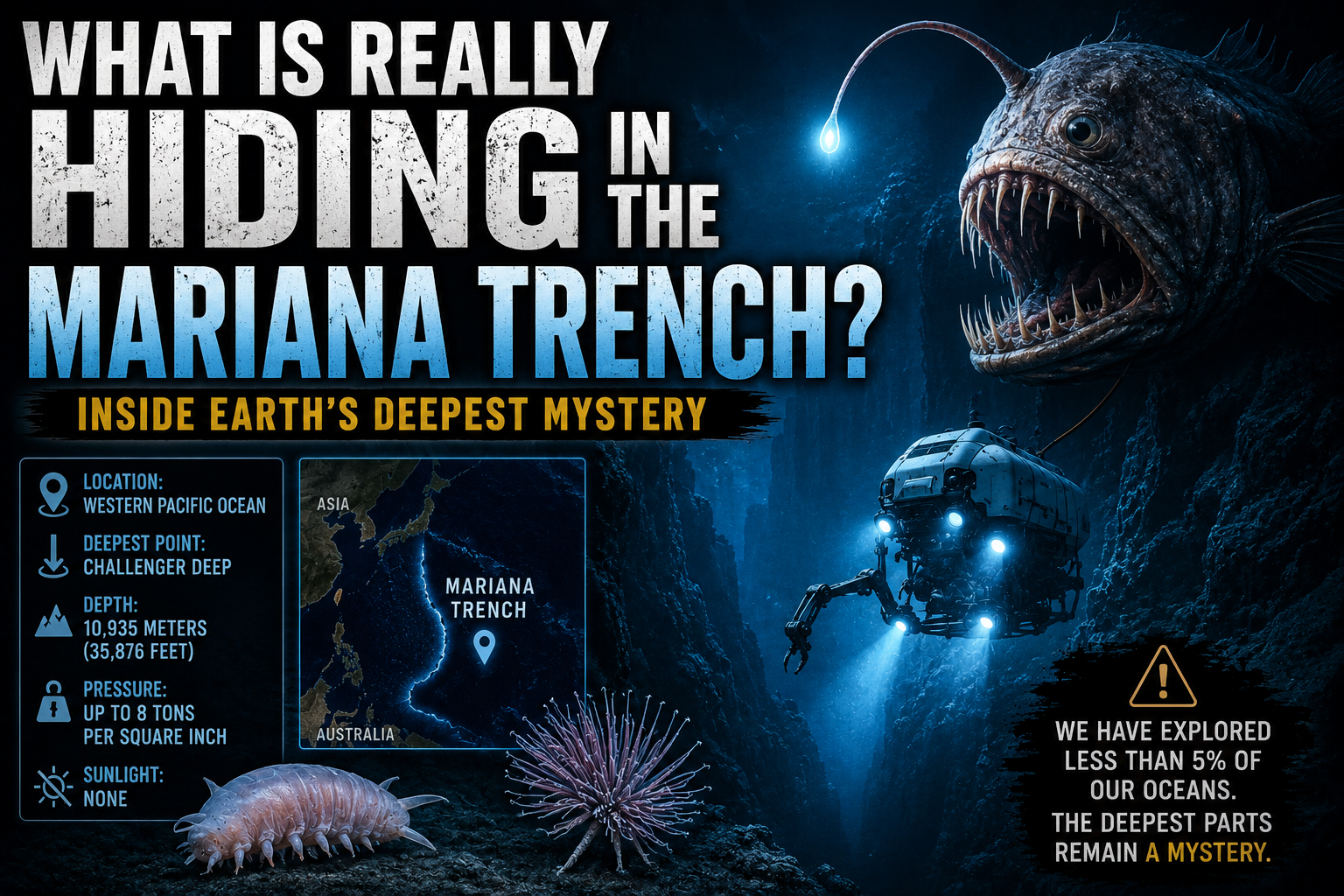
Located in the western Pacific Ocean, the Mariana Trench contains the deepest known point in Earth’s oceans: Challenger Deep. It descends roughly 10,935 meters — about 35,876 feet — below sea level.
That is nearly seven miles down.
If Mount Everest were placed inside the trench, its summit would still sit beneath the ocean’s surface.
Yet despite living in an age of satellites, artificial intelligence, reusable rockets, and machines capable of traveling beyond our solar system, the deepest parts of our own planet remain extraordinarily difficult to study.
So what is really hiding in the Mariana Trench?
The confirmed discoveries are already bizarre.
And the things we still do not know have turned the trench into one of the greatest mysteries on Earth.
First, How Deep Is the Mariana Trench?
The Mariana Trench stretches across the western Pacific near the Mariana Islands and Guam.
Its deepest known region, Challenger Deep, reaches approximately 35,876 feet below sea level, according to NOAA.
To understand how extreme that is, consider this:
Commercial airplanes often cruise at altitudes around 30,000 to 40,000 feet.
The Titanic wreck lies roughly 12,500 feet beneath the Atlantic.
Challenger Deep is almost three times deeper than the Titanic wreck.
At the bottom, the environment belongs to what scientists call the hadal zone — the deepest region of the ocean, generally extending from about 6,000 to 11,000 meters below the surface.
The name comes from Hades, the ancient Greek god of the underworld.
And once you understand what conditions are like down there, the name feels appropriate.
The Pressure Is Almost Unimaginable
One of the greatest barriers to exploring the Mariana Trench is pressure.
As you descend through the ocean, the weight of the water above increases dramatically.
At the deepest point, NOAA has described pressures of roughly eight tons per square inch — around a thousand times the atmospheric pressure humans experience at sea level.
Ordinary equipment cannot simply be lowered to the bottom and expected to survive.
Vehicles must be specially engineered.
Camera housings must withstand enormous forces.
Electronic systems can fail.
Tiny structural weaknesses can become catastrophic.
This is one reason the trench remains so mysterious. It is not simply far away.
It is physically hostile to the machines we need to explore it.
There Is No Sunlight
The bottom of the Mariana Trench exists in permanent darkness.
Sunlight disappears long before reaching these depths. There are no normal days or nights. No sunrise. No moonlight.
Without artificial lights carried by a submersible or robotic vehicle, a human observer would see nothing.
But darkness does not mean emptiness.
Life has adapted.
Some deep-sea organisms use bioluminescence, producing their own light through biological processes. Others rely on chemical signals, extreme sensitivity, unusual feeding strategies, and bodies adapted to survive crushing pressure.
The deeper scientists explore, the stranger life can appear.
The Mariana Snailfish Changed What We Thought Fish Could Survive
One of the most fascinating animals associated with the trench is the Mariana snailfish.
It does not look like a giant sea monster.
In fact, it looks almost fragile.
The fish has a pale, soft body and lives at extraordinary depths where most familiar fish could never survive.
Researchers have documented Mariana snailfish at depths greater than 8,000 meters.
Its existence is important because it demonstrates something remarkable:
Even in darkness, cold temperatures, limited food, and crushing pressure, vertebrate life can survive.
But fish appear to have limits.
Scientists believe extreme biological pressures may prevent fish from living all the way at the absolute deepest bottom of the ocean.
Below that boundary, other forms of life still persist.
Which raises an obvious question:
What else has adapted to survive where we have barely looked?
Giant Creatures? Here Is What We Actually Know
The Mariana Trench has become a magnet for internet stories about enormous unidentified creatures.
Videos online claim to show:
- Giant sharks
- Unknown sea monsters
- Surviving prehistoric animals
- Massive squid
- Creatures larger than whales
- Unidentified shapes following submarines
- “Leaked” footage from secret expeditions
Most of these claims are unsupported, misidentified, exaggerated, or completely fabricated.
There is no credible scientific evidence that a giant prehistoric monster is secretly living at the bottom of Challenger Deep.
There is also no verified evidence that a megalodon survives in the trench.
In fact, the trench would be a strange home for a giant shark that evolved to hunt large prey. The deepest regions are cold, dark, isolated, and limited in available food compared with productive surface waters.
But dismissing fake monster videos does not make the real ocean boring.
The truth is that scientists continue encountering organisms with unusual bodies, strange survival strategies, and adaptations that can look almost extraterrestrial.
The mystery is not that we know a monster is hiding there.
The mystery is that our observations remain limited enough that new discoveries are still possible.
Could Unknown Species Be Living There?
Absolutely.
That does not mean a 500-foot sea monster is waiting in the darkness.
It means scientists have not identified every species living in the world’s deepest environments.
Deep-sea exploration repeatedly reveals organisms that are new to science, poorly understood, or difficult to classify from video alone.
NOAA-led research in the Pacific deep sea has highlighted just how difficult identification can be. In one broad analysis of visible deep-sea organisms observed during expeditions, fewer than 20 percent of species in sufficiently visible groups could be identified to the species level.
That does not mean 80 percent were definitely brand-new species.
But it demonstrates how incomplete our understanding can be.
At extreme depths, the challenge becomes even greater.
Researchers may have only a few images.
A specimen may be damaged during recovery.
Some animals may never approach cameras or baited landers.
Others may occupy tiny habitats that expeditions simply miss.
So yes — unknown life is almost certainly part of the story.
The question is what form that life takes.
The Hadal Zone Is Like a Hidden World
The deepest trenches are not simply empty cracks in the planet.
They contain ecosystems.
The hadal zone stretches from approximately 6,000 to 11,000 meters deep and consists largely of trenches and troughs separated across the ocean.
These environments can contain:
- Amphipods
- Sea cucumbers
- Microbes
- Worms
- Crustaceans
- Snailfish
- Other highly specialized organisms
Food is one of the greatest challenges.
With no sunlight, normal photosynthesis cannot support ecosystems at the bottom. Organic material may fall from upper waters in what scientists sometimes describe as marine snow — a slow rain of biological material descending through the ocean.
Dead organisms can also become major feeding events.
Some deep ecosystems depend on chemical energy rather than sunlight.
The result is a world that operates under rules very different from the surface.
Strange Sounds Have Added to the Mystery
The ocean has produced mysterious sounds that once baffled researchers.
Perhaps the most famous is the Bloop, an extremely powerful underwater sound detected in 1997.
Because of its unusual characteristics and enormous detection range, the sound became the center of countless theories.
Some people imagined a gigantic unknown animal.
Others suggested a creature larger than anything science had ever documented.
The real explanation is far less monstrous. NOAA scientists later linked the sound to ice-related activity, often described as an icequake.
But the Bloop remains part of deep-ocean mythology because it represents something psychologically powerful:
A sound came from a remote part of the ocean.
At first, people did not know what caused it.
And in that gap between detection and explanation, imagination took over.
The Mariana Trench inspires the same reaction.
When people know a place is difficult to reach, difficult to observe, and filled with strange life, mystery becomes almost inevitable.
Human Beings Have Actually Reached the Bottom
Despite the extreme conditions, humans have descended into Challenger Deep.
In 1960, Jacques Piccard and U.S. Navy Lieutenant Don Walsh reached the bottom aboard the bathyscaphe Trieste.
Their journey became one of the greatest exploration achievements of the 20th century.
More than five decades later, filmmaker James Cameron completed a solo descent in 2012 aboard the Deepsea Challenger.
Additional crewed expeditions followed in later years, using advanced full-ocean-depth submersibles.
But even successful dives provide only limited windows into an enormous environment.
Imagine landing a spacecraft in one tiny location on another planet, looking around for several hours, and then claiming the entire world had been explored.
That is part of the challenge with the Mariana Trench.
Reaching the bottom is extraordinary.
Understanding the entire trench is something else.
One of the Darkest Discoveries Was Not a Monster
Perhaps one of the most disturbing discoveries connected to the deepest ocean is evidence of human pollution.
Explorers have reported human-made debris at extreme depths.
Plastic contamination has reached environments once imagined to be completely isolated from civilization.
That means one of Earth’s most remote places is not truly untouched.
Humans may struggle to reach the deepest ocean.
Our pollution does not.
The idea is unsettling: before we have fully documented what lives in some of these environments, we may already be changing them.
What About the Viral Mariana Trench Videos?
Social media is filled with supposed footage from the trench.
Many clips show enormous creatures swimming past submarines or shadowy shapes moving through the darkness.
Be skeptical.
A large number of viral deep-sea videos are:
- CGI
- AI-generated
- Footage from movies
- Video game clips
- Real animals with false captions
- Creatures filmed somewhere completely different
- Edited footage designed for engagement
One major warning sign is a video claiming scientists “refuse to explain” something while providing no expedition name, date, research organization, original footage, or scientific source.
Real unexplained observations can happen.
But extraordinary claims require evidence.
A blurry shape with dramatic music is not proof of a hidden monster.
Could a Megalodon Be Hiding in the Trench?
This is one of the most popular theories online.
The short answer is:
There is no credible evidence that megalodon still exists.
Megalodon was a massive prehistoric shark that disappeared millions of years ago.
The Mariana Trench theory is especially weak because giant predatory sharks require food. A breeding population would need enough prey, genetic diversity, and ecological support to survive over long periods.
A huge shark population would also likely leave evidence:
- Bodies
- Teeth
- Bite marks
- Environmental DNA
- Repeated sonar detections
- Reliable visual observations
None of this has established the survival of megalodon.
The trench is mysterious.
But mystery alone is not evidence.
So What Is Really Hiding Down There?
The most accurate answer is both less dramatic and more fascinating than the conspiracy theories.
We know the Mariana Trench contains highly specialized life capable of surviving conditions that would kill most familiar organisms.
We know deep-ocean ecosystems are still incompletely understood.
We know new species can be discovered.
We know our ability to observe the deepest environments is limited by pressure, cost, engineering, distance, and time.
We know some viral claims are fake.
And we know there are still scientific questions waiting to be answered.
What we do not have is credible evidence of giant hidden monsters, underwater civilizations, surviving megalodons, or government-covered-up creatures.
But that does not mean the trench has revealed everything.
Far from it.
Final Thought
The Mariana Trench does not need a fictional monster to be terrifying.
The reality is powerful enough.
Nearly seven miles beneath the ocean surface lies a world of crushing pressure and permanent darkness. Strange organisms survive where humans cannot exist without some of the most advanced vehicles ever built. Expeditions can visit, record, sample, and map — but every mission is limited.
We have seen pieces of this world.
We have collected specimens.
We have reached the bottom.
But reaching a place is not the same as fully understanding it.
So what is really hiding in the Mariana Trench?
Probably not the monsters social media promises.
But almost certainly more than humanity has discovered.
And until we explore more of the darkness, the deepest place on Earth will continue keeping some of its secrets.